

What should a good manicure and pedicure drill have?
When thinking about how to choose a manicure drill, it is easy to fall into the temptation of looking only at the highest number of revolutions or the lowest price. But a good piece of professional equipment is defined by the set of its features, not by a single isolated piece of data: real power under load, the quality of the handpiece, the ability to adjust the speed precisely, and comfort during long workdays weigh as much as the maximum revolutions shown on the technical data sheet.
Knowing how to choose a professional drill largely comes down to understanding what nail drill to choose according to your real needs and how each feature translates into daily work with different materials and procedures.
RPM, power, and torque: what do they really mean?
Before comparing models, it is advisable to be clear about what these three terms that appear on almost any technical data sheet really mean.
Rotational speed (RPM)
Revolutions per minute, or RPM, indicate the speed at which the drill bit rotates. How many RPM a nail drill should have depends on the type of work: delicate procedures, such as working near the cuticle, require low and highly controllable speeds, while removing acrylic or gel material from previous builds can benefit from higher speeds. In general, what RPM to use for manicures is best addressed by thinking about the low speed range, since a very high maximum number is not very useful if the equipment does not allow that speed to be adjusted precisely, which is where most delicate procedures are performed.
Power and torque
Power determines how much energy the motor can deliver, but torque - the rotational force - is what you really notice when the drill bit encounters resistance, for example when working on a dense acrylic build. What power a nail drill should have depends on the use, but as a general rule, it is advisable to prioritize a motor that maintains a stable rotation under load over one that only stands out in maximum no-load power. What the torque of a nail drill is is best understood with an example: a motor with low torque loses speed or stops when pressure is applied, while one with good torque maintains a constant rotation even under load, which translates into cleaner work and less effort for the professional.
The handpiece: a key factor for daily work
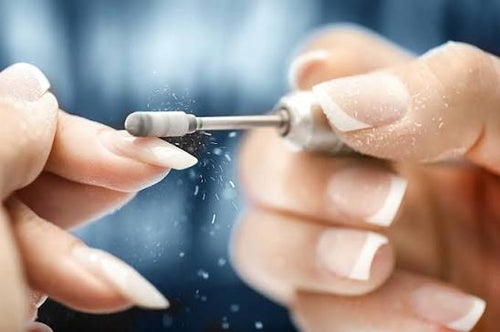
The handpiece is the part of the drill with which you work directly, and its design influences both the result and the comfort of the professional. Weight is an important factor: a handle that is too heavy causes fatigue in the wrist during days with several clients in a row. Ergonomics - the thickness, the balance between the cable and the body of the piece - also affects the precision of movement in delicate procedures.
Vibration and heating are two other aspects to watch: a handpiece that vibrates excessively makes fine control difficult, while noticeable heating after prolonged use can be uncomfortable or even indicate a problem with the motor. Among the features of a good nail drill, the quality of the handpiece usually makes more difference in the day-to-day than the maximum power or RPM figures.
What drill to choose for manicure and which for pedicure?
The differences between a manicure drill and a pedicure drill have to do above all with the intensity of the work. In manicure, a good part of the procedures require precision and low or medium speeds, especially when working near the cuticle or retouching fine details. In pedicure, on the other hand, it is common to work on thicker skin or calluses, which can require more power and specific accessories for that type of treatment.
This does not mean that there is a universally better model for all cases: many professional drills are designed to cover both uses, and the final choice depends on what procedures you perform most frequently and the work intensity of your station.
What to consider before buying a professional drill
Before deciding what drill to buy for manicure, it is useful to follow a logical order: first, identify the procedures you perform most frequently; then, assess the intensity of use - occasional, daily, several clients in a row; from there, review the RPM range and the torque available in each model; check the comfort of the handpiece; and finally, assess the ease of control and maintenance of the equipment.
With these criteria clear, comparing models becomes much easier. At CAREHUB PRO you will find the range of professional nail drills ÜLKA, with different options that you can assess according to these same points, and that you can combine with the nail dust collectors necessary to keep the workstation clean throughout the service.
Frequently Asked Questions
How many RPM should a professional drill have?
There is no single figure: the important thing is that the equipment allows you to adjust the speed precisely in the low range, where most delicate procedures are performed, in addition to offering more revolutions when material needs to be removed.
What is more important: power or RPM?
Both features work together. Power and torque determine if the motor maintains speed under load, while RPM indicates the rotational speed; a balanced piece of equipment in both aspects usually gives better results than one that stands out in only one of them.
What drill to choose for manicure and pedicure?
It depends on the procedures you perform most frequently: if you work both techniques regularly, it is advisable to look for a versatile model with good speed control and enough power for the calluses typical of pedicure.
Why does a drill handpiece vibrate?
It may be due to a poorly fitted drill bit, motor wear, or a lower-quality design in the internal balancing; excessive vibration should be checked, as it makes control difficult during delicate procedures.
What features are important for professional use?
In addition to power and torque, it is advisable to look at the quality of the handpiece, the ability to adjust the speed precisely, and the equipment's resistance to continuous use throughout the day.


0 comments